The Rimini Rencontre, formally the Rencontre for Friendship Among Peoples, is one of the most significant annual gatherings in Italy for dialogue among people of different cultures, religions, professions and convictions. It began in 1980, emerging from a Christian experience inspired by the desire to discover and share what is true, good and beautiful in contemporary life. Over more than four decades, it has grown into a major international forum where questions of faith, culture, politics, science, economics, art and social life are explored through encounters, exhibitions, debates and performances. What makes the Rencontre particularly distinctive is its understanding of difference not as something to be overcome, but as an opportunity for encounter.
This year Pope Leo XIV visited the 47th Rencontre in Rimini on 22 August 2026, His Holiness described the name “Rencontre for Friendship Among Peoples” as having a particularly prophetic meaning in a world marked by conflict and division, emphasising that peace is built by people who are willing to encounter one another and become friends.
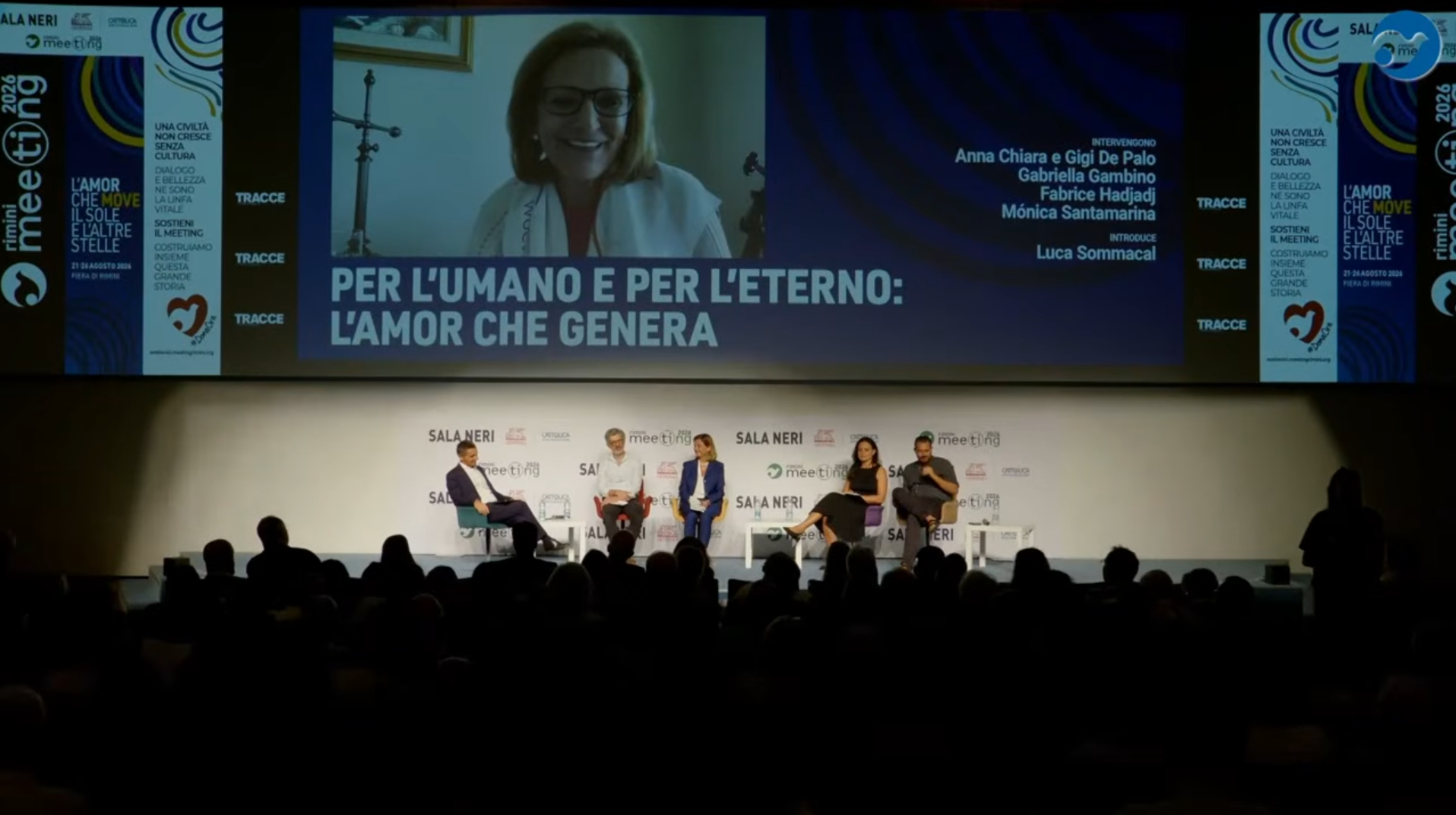
I had the honour to participate in the panel session of the Rencontre ‘For the Human and for the Eternal. The Love that Generates‘ on August 24. I was invited to reflect, together with Prof. Fabrice Hadjadj, Prof. Gabriella Gambino and Anna Chiara and Gigi De Palo on the family as the privileged place where the human person is born and develops, as an expression of love, and as a source of community and social transformation. I had the opportunity to share on the experience and mission of WUCWO and I am happy to share with you the full intervention for your own discernment on family, women, bonds and hope.
Community as a Resource for the Family and for Society: Education in the Value of the Person
Good afternoon, everyone.
It is an honour for me to take part in this gathering, even if on this occasion I do so from a distance. For more than 25 years, the Rimini Meeting has been a privileged space for dialogue, culture and the search for truth. Thank you for allowing the voice of the world’s organised Catholic women to be present here.
I should like to begin with the words of a mother from Kenya, who took part, together with other parents, in a family-strengthening programme built around positive parenting. When it ended, she told us:
“I used to feel isolated and unable to raise my children responsibly.”
I should like to pause for a moment on this word: isolated. Because when we think of the difficulties families face, what comes to mind straight away are economic problems, violence, migration, the challenges of raising children or tensions within the home. All of that is real. But there is a suffering that makes those difficulties even harder to bear: the feeling that we must face them alone.
We live a paradox. We have more means of communication than ever before, yet we often have fewer spaces in which to feel truly welcome; places where someone will genuinely listen to us.
This is why one of the great invitations of Amoris Laetitia is so significant: the invitation to “accompany”.
In this Exhortation, Pope Francis states that the Church wishes to draw near to families with humble understanding, accompanying them so as to help them overcome the difficulties they meet along the way (AL, 200). He reminds us that families do not need to be perfect in order to be places where God acts. They need to be listened to, sustained and accompanied. They need to know that, when difficulty arrives, they are not alone.
And this is where the Church and the community take on decisive value: not to replace the family, but to strengthen it; not to take away its responsibilities, but to restore its strength. They do not remove a family’s problems, but they ensure the family does not have to face them alone.
This is a reality that we, in the World Union of Catholic Women’s Organisations, WUCWO, have experienced for more than 115 years.
Today we represent more than eight million women from every continent. We come from different cultures, we speak different languages, we live very different realities. And yet, when we come together, we discover that our joys and our concerns are very similar.
We want to build good marriages and see our families flourish with dignity. We want to care for our children and grandchildren. We want to live in peace, to be listened to, respected and valued. And time and again we find that life changes when someone walks alongside us.
When a woman stops feeling alone and is supported in her integral development, a transformation begins that reaches her whole family, her community and, very often, an entire society. That is precisely the great value of a worldwide network such as ours.
I like to define WUCWO not merely as an international organisation, but as a community of communities: a global network of women sustaining other women, so that they, in turn, may sustain their families and their communities.
At our last General Assembly, we agreed on a priority: “To undertake, with renewed conviction, the joyful path of family love, motherhood and fatherhood.”
And how do we go about fulfilling that priority? Firstly, by representing women and families and making their voice heard, so as to bring about real influence and change.
Through our more than 100 grassroots organisations and our World Women’s Observatory, we listen to thousands of women across the globe, especially the most vulnerable, and we carry their voice to bodies such as ECOSOC, the Human Rights Council, the Council of Europe and UNESCO, pressing for concrete action in favour of human dignity and the family.
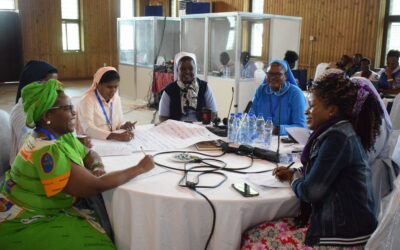
Our network allows us to connect with one another, share experiences, build synergies and foster solidarity among women and organisations from different countries and continents, translating all of this into pastoral action, civil society initiatives and contributions to public policy. In Africa alone, we have a network of more than 100 lay and religious organisations across 22 countries, working to prevent and eradicate violence against women, particularly within the family.
We also provide formation in women’s leadership, family life, motherhood and fatherhood, and care for the most vulnerable, grounded in Gospel values. We run global campaigns such as “Device Free Family Meals”, to help restore conversation within the home.
Yet the most important work of our network does not take place at grand international gatherings. It happens every day, often unnoticed, in communities and parishes where generous, courageous and committed women from our organisations accompany other women, families and young people — especially those who are struggling.
Allow me to speak of a project I know well, since it comes from one of the organisations in my own country, though it is repeated, with variations, in many of our organisations around the world. In the Unión Femenina Católica Mexicana we founded, many years ago, the “Young Wives and Mothers” programme, to offer integral formation and a space for listening to young women, whatever their marital status or family situation.
The greatest richness of these groups has been giving the women a meeting point where they can share experiences, receive guidance and feel accompanied. The impact is clear: many of those young women now have more stable families and take on responsibilities effectively, both in the Church and in society. Most of the organisation’s current leaders came up through that very programme.
And now I would like to return to that mother from Kenya. In the Diocese of Embu, 268 fathers and mothers took part in a positive-parenting programme that we promoted to strengthen dialogue, shared responsibility within the family and the prevention of violence.
The changes some of the participants described at the end may seem small. But when we view them from within the life of a family, we discover that they are enormous.
One father shared that he used to make all the household’s financial decisions on his own; after the programme, he began sitting down with his wife so they could decide together what to spend and what to save. A mother told how her husband began taking on responsibilities towards the family and the upbringing of their children that he had previously ignored.
And that woman whose words we heard at the beginning said, when the course ended:
“Now, when my children come to me, I listen to them, I talk with them, and I guide them.”
What happened there? These did not become perfect families. They became accompanied families. And when a family is accompanied, it discovers capacities that were already within it, but which loneliness or suffering had prevented it from recognising.
The Church and the community are not merely networks that provide services or meet needs: they also shape our understanding of the human person.
They teach us that a woman’s identity cannot be reduced to the situation of violence she is going through. That a single mother cannot be defined by what she lacks. That a migrant family is not a statistic. That a person who comes from another culture, who speaks another language or who is going through a situation of vulnerability, possesses exactly the same dignity as each one of us, and deserves to be welcome, listened to and respected.
That a young woman starting a family needs the support of her employer, the Church, the community, the government and, of course, of her husband and her own family, in order to achieve a healthy balance between her personal, family, working and spiritual life.
All of this is especially important when we think of our young people. Respect for the dignity of others is not learnt only from books or through fine speeches. It is learnt within relationships.
A young person learns to respect others by seeing how the members of their own family respect one another, and how that family helps those in greater need. They learn that differences need not become distance, when they meet someone, whose story is different from their own. They learn to respect vulnerability when they discover that needing others does not diminish a person’s worth. And they learn that love is not merely a feeling, when they take part in a community where people listen to one another, forgive one another, serve one another and care for one another.
The circumstances in Kenya and in Mexico are very different. But behind them lies one and the same deeply human need: we need to know that we belong. That someone knows our name and is waiting for us. That our life matters to another person.
And that, to my mind, is one of the great gifts that community, the Church and, of course, the strength of a worldwide network such as WUCWO can offer. Our diversity does not disappear when we come together; on the contrary, it becomes a richness. But it all begins with one person drawing near to another.
This is why Pope Francis insisted so strongly on a culture of encounter, and why Pope Leo XIV reminds us today of the need to rebuild peaceful societies by strengthening families. Peace enters the world through relationships: it is born wherever there is trust and reciprocity between people, and those relationships are learnt, above all, within the family — there we discover that the other is not a rival, but a gift.
For peace does not begin with grand agreements between nations. It begins much earlier: when a husband and wife learn to listen to and forgive one another. When parents find support in raising their children. When a family opens its doors to someone who is alone. When a community decides not to abandon those who suffer.
For this reason, as a widow who was happily married for 38 years, as a mother of four and a grandmother of nine, I should like to insist on five convictions:
- It is not enough to defend the family. We must help families never to feel alone.
- It is not enough to encourage young people to start a family. We must accompany them and help them overcome their fears.
- It is not enough to talk about love. We must build spaces where that love can be experienced.
- It is not enough to proclaim the dignity of every person. We must foster relationships in which each one can experience being valued, being listened to, and being respected.
- It is not enough to say that no family is built alone. We must convey to young people that starting a family is a wonderful experience, one that fills life with meaning.
Because there is something we have learnt time and again, both personally and through our associative journey: whoever has been supported learns to support others. Whoever has been listened to learns to listen. Whoever has been welcomed learns to welcome.
This is how love generates life: it passes from one person to another; from a woman to a family; from a family to a community; and from a community to a society.
All of us, at some point in our lives, need someone to walk alongside us. People will probably not remember our speeches. But they will hardly forget whoever stood by them when they needed it most.
For authentic love never closes in on itself.
Love opens.
Love builds.
Love generates life.
And that love — the Love that moves the sun and the other stars — still has the power to move our world as well.
Thank you very much!
Mónica Santamarina
WUCWO President General