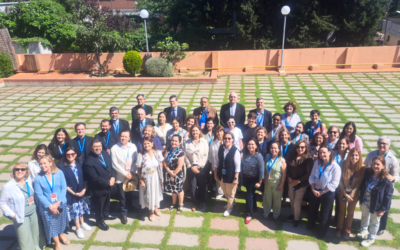

Interview with Alberto.
“I am a doctor, a child and adolescent psychotherapist, but also a researcher at the University of Milan. I have always worked in the field of clinical prevention in childhood and adolescence, and my profession has also had a significant impact on my personal life, as I am a father of four children; so the two have run parallel for the last 25 years.”
Artificial intelligence and new technologies are transforming the world in which children and adolescents learn, interact and access information: what are your thoughts on this?
As a person grows up, they need tools that support their development, and artificial intelligence is actually a highly beneficial tool, of great importance to human beings. For me, as a doctor, it facilitates diagnosis and treatment; it allows me to find information very quickly, but I can use it as a tool to complement my profession, whilst children and adolescents first and foremost need to develop their brain’s capabilities and equip it with cognitive power, so that artificial intelligence may subsequently become a tool at the service of our cognitive functions. It is we who control it.
When you have not yet reached that level of cognitive maturity and have not developed the necessary skills — because these are formed precisely during childhood — there is a risk that the tool will actually end up controlling you. Ultimately, at a stage when you should be developing complex skills and competencies, you may fail to do so because you find them all ready-made in something external to yourself, on which you will become dependent. This is because you will not have done the work on yourself that enables you to do without.
What skills do they need to learn to use it properly, and what is the minimum age below which it is best not to let them use it?
There is a major debate in Europe about restricting the use of social media before the age of 13. Discussions are focusing on the age below which it is absolutely inadvisable to give a child their own smartphone – which currently seems to be around 14 – and the age below which it is inadvisable for a minor to sign up to a social media platform, which seems to be around 16.
We have measured these effects on Generation Z – those born between 1997 and 2010 – who, from 2011 onwards, have always had portable digital devices at their fingertips (they existed before then, but production on a large scale began from this date): Generation Z is the generation with the worst mental health indicators ever recorded during adolescence; there has also been a very marked decline in mental health during childhood, with characteristics we had never seen before.
More generally, we can say that research has shown us that, simultaneously across all five continents during childhood and adolescence, four very significant phenomena have occurred:
- Sleep deprivation
- Impoverishment of social relationships.
- Cognitive decline: the Flynn effect – whereby each generation has consistently had a slightly higher IQ than the previous one – is no longer occurring; recent generations have lost this cognitive advantage in terms of cognitive functioning, and we now have new generations with a lower IQ than their predecessors
- Addiction
What should be the role of parents, educators and other adults who support children and adolescents during this developmental stage?
An important task for adults is to change the logic of these platforms: they have proliferated and reaped enormous economic benefits over the last twenty years; they have been ‘free zones’ that have never had to answer for their educational, ethical or legal responsibilities, claiming that the responsibility lies with parents.
In your view, setting aside technology, what are the main difficulties and needs you observe in children and adolescents today, and how can we support them so that they develop the tools needed to tackle these challenges?
The main challenge facing children and young people is precisely the change in the environments where our children learn to navigate life:previously, the tools were play and relationships with friends; today they spend between 3 and 6 hours in a virtual ‘gym’ that does absolutely nothing to help them acquire the same skills and competences as in real life. In the educational community, there are educators, adults and supervisors who have an educational programme; in the digital world, there are influencers who have a commercial agenda, so they have absolutely no interest in looking after children’s development..
Families must join forces: I advise every family to pair up with at least one other family who has a child of the same age as their own, and to meet up with them at least once a week.
To Go Further: Ten Principles for Reclaiming Adult Authority

In his book Allenare alla vita. I dieci principi per ridiventare genitori autorevoli (Mondadori, 2024), physician and psychotherapist Alberto Pellai reflects on the role of adults in educating children and adolescents. In a social media post, he shares ten principles for reclaiming educational authority and guiding younger generations as they grow:
- Reclaiming adult authority.
- The virtual is not real: delay smartphone use for as long as possible.
- Building educational partnerships with other adults.
- Teaching children that they do not always have to be first.
- Understanding that speed is a false ideal.
- Rediscovering sensitivity.
- Filling the inner void.
- Moving from “I” to “we”.
- Not geolocating children.
- Rediscovering the spiritual dimension in the process of growing up.
WUCWO Communication Office
(Original: IT)