Interview with Sr. Clémence
“Building together a new civilisation where the poor are not problems to be solved, but brothers and sisters to be welcomed.” Dilexi te
On the day the Church commemorates St Francis of Assisi, Pope Leo XIV signed his first apostolic exhortation Dilexi te (“I Have Loved You”), presented in the Holy See Press Office on 9 October, in the presence of Cardinal Michael Czerny (Prefect of the Dicastery for Promoting Integral Human Development) and Cardinal Konrad Krajewski (Almoner of His Holiness). Sr Clémence, of the Little Sisters of Jesus, was also present. On that occasion, she spoke about her experience with the Rom people.
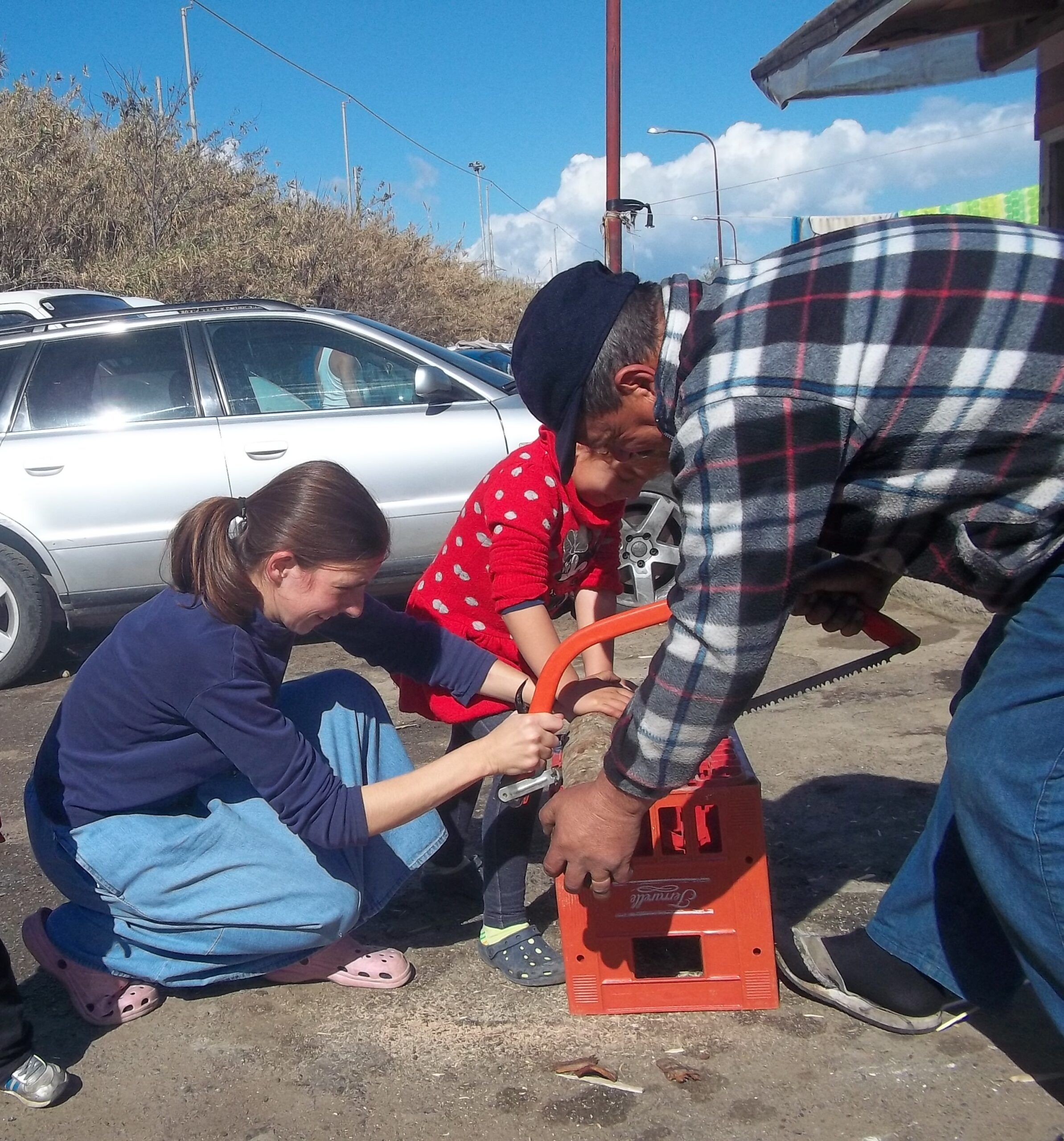
“I would so much like Lacri, Pana, or another of those Roma women from Romania with whom we shared our life for several years on wasteland in the south of Italy, to be sitting in my place right now. These women, who as the exhortation reminds us, because of their exclusion, are ‘doubly poor’, yet in whom ‘we find the most admirable gestures of daily heroism in protecting and caring for the fragility of their families’.. Many of them have never studied, yet they carry within themselves a wisdom shaped by the experience of precariousness, which pushes them towards sharing and solidarity. The Holy Father invites us to recognise the ‘mysterious wisdom that God wants to communicate to us through them’. Following their example, let us rediscover solidarity, because in our concern to protect our own wealth, we often forget it so quickly.” — Sr Clémence [1]
We met Clémence to talk with her about the themes addressed in the Pope’s letter.
Thank you, Clémence, for accepting our invitation. Your charism makes littleness your strength, doesn’t it?
One could put it like that; it’s a beautiful definition. Learning from others, placing oneself in their school, starting with the smallest who carry within them a hidden greatness, and trying to discover it.
Who are the poor? What does it mean today to be a poor person?
It’s a good question, and not an easy one for me to answer. The term “poor” often troubles me in how it is used, because I feel that, in the end, we all carry a “poor part” within us. I have often asked myself: “But really, who is rich, and who is poor?” For example, when I am with my neighbours or work colleagues, who from the outside are considered poor, people who are looked down upon, yet from whom I have often received hope and the courage to keep going.
In that sense, they seemed much richer than I was — so yes, it remains a big question for me.
Poverty is sometimes equivalent to destitution, and that is unacceptable: when people live in conditions where they do not, or cannot, meet their basic needs. That whole reality exists, often linked to other forms of poverty: exclusion, marginalisation.
Poverty in our societies takes many forms.
Today, there is also, in part of our societies, a certain spiritual poverty: not seeing meaning, stopping at what we live, unable to perceive a dimension beyond… and I believe that is also a deep poverty for some.
Selfishness — thinking only of oneself — is also a great poverty of our world, and it is a poverty I often fall into myself.
The word “poverty” can be understood in many ways. Sometimes I wish the poor themselves could speak about it and give us their vision.
Often they do not see themselves under that label of “poor”. It is something we impose on them.
Another thing that makes me reflect deeply is vulnerability, which shapes all of us. There are moments when we feel it more acutely. But truly, the first temptation — if I listen to my own experience — is to hide this poverty, to keep it far from us, to do everything so that it is not seen, sometimes even at the cost of making the other poorer: by crushing them, dominating them… everything seems allowed as long as my own fragility remains hidden.
Thank you, Clémence. It’s very interesting: in the Pope’s letter he invites us to learn from the poor, to dialogue with them, to listen to them, because they can offer a perspective we do not see.
Is there a power dynamic between the person who helps and the person who receives, the poor person?
It was truly a joy for me to find, in the exhortation, this invitation to listen to what the poor have to tell us and to look at the world from their perception.
Returning to my experience with the Roma, I really sensed how the more I lived with them, the fewer certainties I had about what was good or just — and especially about what was good for them.
Often, we approach others saying: “We’re going to bring them what they lack — a house, work, education…” but acting according to what we think is good, right, best.
By placing ourselves in their school, we discover a reality animated by great values as well, but read differently.
I’ll give a very concrete example: education.
We worked a lot to support mothers and families who wanted to enrol their children in school, to encourage and help them.
Yet at the same time, seeing what the school actually offered those children raised many questions in me. I asked myself: “But if this only makes them experience further humiliations, further situations where they fail, further moments of being the last ones, judged… is this really right? Is this giving them keys for their future? Or is it widening the gap between them and us?”
It’s not that they don’t need education — they do — but perhaps in another way. They learn in a very concrete, practical way. They learn by living alongside their parents: watching their father repair cars and discovering how an electrical or mechanical circuit works. That too is a form of knowledge.
Is it possible to bring these two visions of humanity together — both valid — so everyone can flourish?
Another big issue is the lifestyle of those living in very precarious conditions. They need housing, yes — but at what cost? Often, to give them a house, we uproot them from their community; we isolate them. We move them away from the places where they had found minimal sources of income. I am thinking, for example, of families who survived by collecting scrap metal and selling it. If I place them in a flat where they no longer have access to that resource, they can no longer support their family.
We see problems through our own lens, and we struggle to perceive the complexity behind them, to see what they themselves have put in place to survive, their own economy…
They too have a worldview. Community is extremely important for them — something beautiful, something we tend to have lost.
So when we take away their ability to stay together, we deprive them of that value and of what they have to share with us. For me, it would be beautiful if we could learn from them the strength of community, the mutual support they live so naturally.
We often live in a world with “us who help” on one side and “them who are poor” on the other. And perhaps — and I’m pushing it a bit — maybe it even suits us that some people remain poor, because then we can feel useful and important.
Yet they have so much to give us. They know what they want, what they need. Sometimes what is lacking are the tools, the spaces where they can speak, reflect with others.
This mutual richness that can be shared — I have seen it with the Roma, but also in the south of Italy, in Naples, where I lived and witnessed the strength of these women in their daily lives: facing the struggle to find work, supporting their families, with an energy that always amazed me, nourished me, and helped me grow humanly and spiritually.
When we approach others in this way, I believe it can change many things.
Thank you, Clémence. Listening to you, I am reminded of the paragraphs where the Pope invites us to consider the poor as subjects. We are not “the centre”; those who help are not always central, and at some point any of us can become the “periphery”. Il peut arriver que nous soyons nous-mêmes ceux qui ont besoin. Je voudrais te demander ton expérience de pauvreté : une expérience de fragilité ou tu t’es sentie pauvre et a reçu de l’aide d’autres personnes.
In recent years, I have felt my own poverty in several areas. I realise it is not easy to find the words to express this.
I felt myself reaching my limits, and touching a deep wound within me, which resurfaced in relationships and encounters with others, in ways I could no longer manage. I lived moments when I felt very small, because I no longer had the strength or energy to move forward.
I experienced moments when everything seemed to collapse — everything I thought I was. I realised I could no longer pray; I couldn’t sleep…
I had no energy for relationships with my sisters.
These were moments of great loneliness, because I sometimes felt misunderstood, not welcomed with my vulnerability — because vulnerability can frighten others.
I really faced my desire to “be the good little sister”, the one who listens to everyone, who is always present, who has energy for everything — and I discovered that this was not the reality at all.
I think what saved me at that time was, above all, living in community and the welcome of my sisters. It wasn’t easy — at times I felt like a burden — but there was also their welcome and understanding. What helped me a great deal in those more difficult moments were also our neighbours, our friends, and seeing their courage in facing their own struggles.
Thank you to Pope Leo for the message offered to us today, this call to “a poor Church and for the poor”, but above all “with the poor”.
Patrizia Morgante
Who is Sr Clémence?
Belgian, she was born in 1982 in Brussels. In 2002, during the World Youth Day in Toronto, she met the Little Sisters of Jesus for the first time in Montreal. Their simple way of life, close to the people, touched her deeply, and for her it marked the beginning of a long inner journey.
In 2008, after her studies and some work experience, she entered the Little Sisters. She spent several years living in a multicultural neighbourhood of Brussels, where she worked in a shop and an industrial laundry. After her first vows, she was sent to Italy to join the “nomadic fraternity”, where the Little Sisters lived among the Roma from Romania in the south of Italy. In 2022, she joined another fraternity on the outskirts of Naples where, a year later, she made her perpetual vows. After that, she moved to Rome, to the general fraternity, where she still lives today.
[1] To read the testimony, visit the Congregation’s website: https://petitessoeursdejesus.org/dilexi-te/