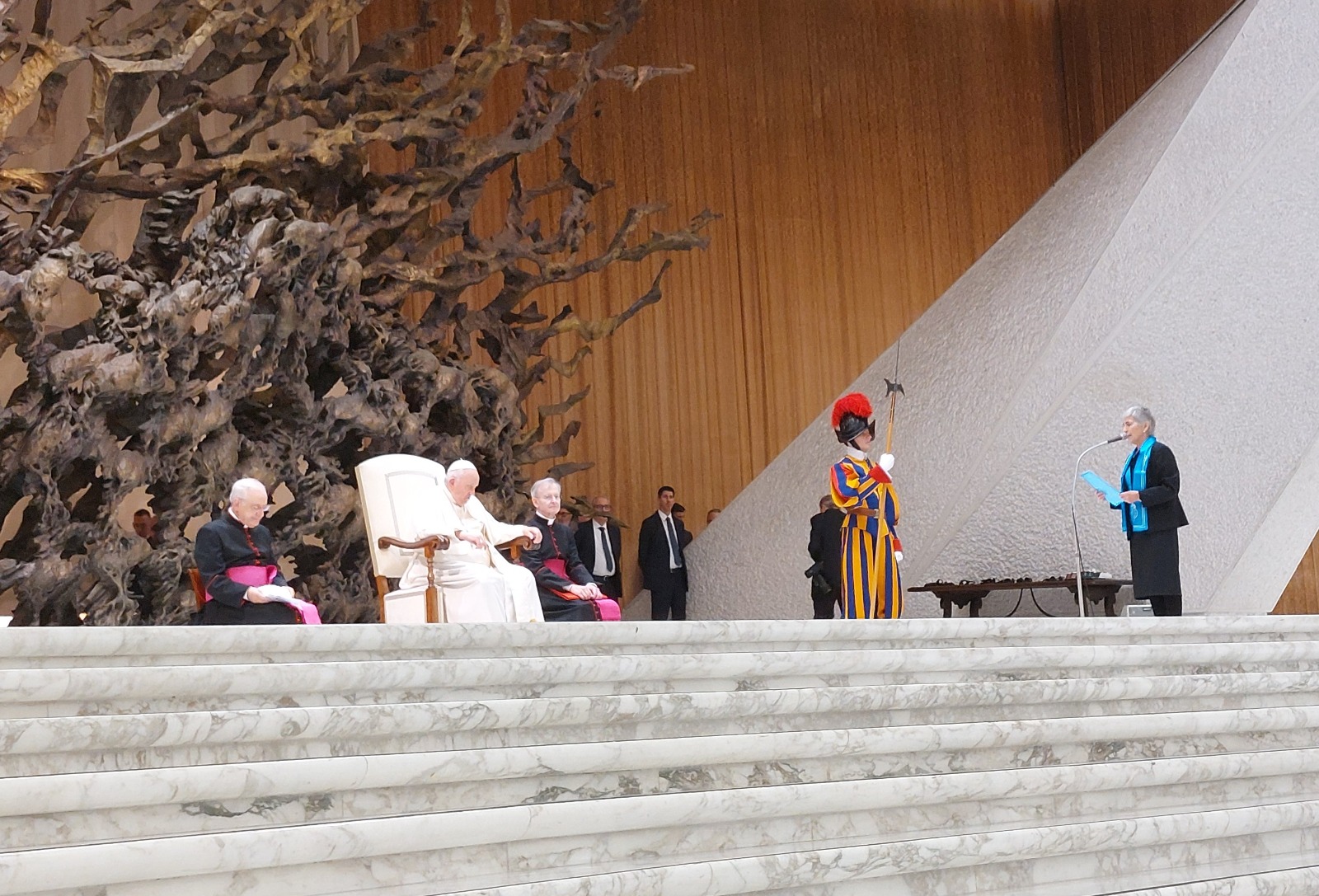
María Lía, you’ve had a close relationship with Pope Francis and now with Pope Leo. What continuity or new developments do you perceive between the two pontificates?
I’d say three words: continuity, originality, and transformation.
There’s continuity because Pope Leo has embraced everything Pope Francis began. Originality, because he has a different personality and history, and lives the pontificate in a different way.
Francis was a prophetic, radical Pope who surprised us daily. Leo, on the other hand, is a pontiff sent by the Holy Spirit to consolidate and reconcile. His inner peace brings peace to others. From the very first moment, when he spoke of “disarmed and disarming peace,” I knew that phrase reflected who he is.
Pope Francis promoted greater lay and female participation in leadership roles in the Holy See through the Apostolic Constitution Praedicate Evangelium. How do you interpret this, and what steps do you think Pope Leo might take?
Praedicate Evangelium was a major shift. The Curia, which used to act as an entity between the Pope and the bishops, now serves both. It’s a structure placed beneath, like Christ washing the feet of his apostles. This opens the door for laypeople—men and women, religious or not—to offer their service if they are properly trained.
Pope Francis already made significant strides in this direction, and Pope Leo will continue along that path. There’s still much to be done, but women must prepare themselves to better serve the Church.
For me, Pilar Bellosillo was always a luminous figure. As president of WUCWO, she often reminded us that although the Church’s teaching on women is excellent, there’s still a large gap between theory and practice. That’s why she dedicated so much effort to promoting greater female ecclesial presence.
I believe Pope Leo will continue appointing women to key positions in the Curia. At the same time, he has made it clear that he will uphold the Church’s teaching on the sacrament of Holy Orders: during his pontificate, the ordination of women—whether to the priesthood or the diaconate—is not foreseen.
However, the entire field of ministries—ordained and non-ordained—remains open, where properly trained women can continue to take on increasingly significant roles.
Recently, the 60th anniversary of Nostra Aetate on religious freedom was celebrated, one of WUCWO’s current resolutions. How can we help promote it?
Pope Leo recently said that religious freedom “is not optional, but the cornerstone of a just society.” Nostra Aetate marked a 360-degree shift: we went from speaking of “perfidious Jews” to recognising them as “elder brothers,” and from calling other Christians “heretics” to considering them brothers.
And it’s not just a matter of terminology—WUCWO women must uphold the right to religious freedom in every country, especially where persecution is implicit or explicit.
You’re part of the Synod’s Ordinary Council. How can WUCWO contribute to this new phase of synodal implementation?
I believe WUCWO is particularly well-prepared. It has already launched a School of Synodality and, through the World Women’s Observatory, understands the fruits of working synodally.
We can offer training to women, priests, and young people to foster active listening, discernment, and walking together.
Synodality isn’t imposed from above—it arises from below, from each community. Every woman, even in small parish tasks, can help walk synodally through conversations in the Spirit. I like to compare it to honey: when it spills, it spreads and permeates everything. That’s how synodality should extend throughout the Church.
Finally, how do WUCWO’s resolutions on integral ecology and family connect with Pope Leo’s priorities?
I recall a powerful image. During the commemoration of the ten-year anniversary of Laudato Si’, Pope Leo blessed a piece of ice brought from the North Pole. He placed his hands on it and said: “I cannot love God, whom I do not see, if I do not love creation, where God reveals Himself.” That gesture sums up his vision: caring for our common home is part of the Christian DNA. If WUCWO women care for our homes and families, we can also care for the planet. And we’ll do it by living synodality within the family: through dialogue, silence, listening, and shared discernment. Only then can we achieve the seven goals of the Laudato Si’ Platform and contribute, in communion, to the good of all creation.
María Lía Zervino, Servidora
María Lía Zervino began her journey with WUCWO (World Union of Catholic Women’s Organisations) in Rome twelve years ago, when she was invited during the presidency of Maria Giovanna Ruggieri to take on the role of Secretary General. She brought editorial experience as head of La Voz de las Mujeres, a mission she carried out through the Argentine Association of Culture, where she belongs as a Consecrated Virgin of the Ordo Virginum Servidoras. At the General Assembly in Senegal, she was elected president. She affirms that WUCWO has been a true school of life for her: faith, courage, cultural diversity, and the deep love for the Church shown by its women. Her path took an unexpected turn when Pope Francis appointed her to the Dicastery for Bishops and the Ordinary Council of the Synod, where she has worked closely with Cardinal Robert Francis Prevost, now Pope Leo XIV.